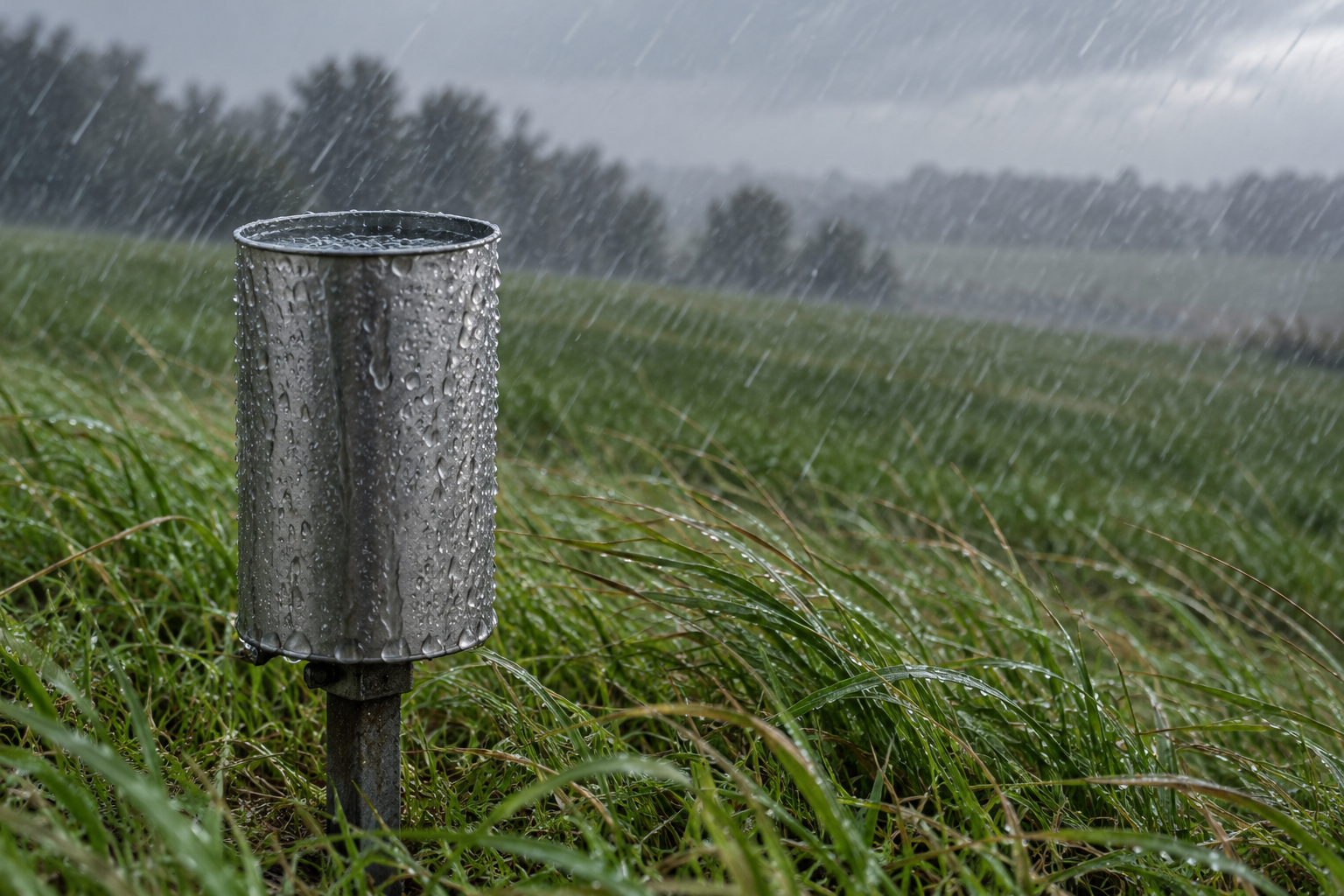
Two gauges can sit a few metres apart in the same rain and report different totals. In a field study at a lowland and an exposed upland site, researchers compared gauges mounted above ground with reference gauges whose openings were level with the ground in pits. The ordinary cylindrical gauge mounted half a metre high caught, on average, 9.4 percent less than its pit neighbor at the lowland site and 23.8 percent less at the upland site. Those are results from the studied sites and instruments, not corrections to paste onto every rainfall record. They show that a rain total depends partly on how the instrument meets the weather.
A gauge measures the water that crosses its rim. The body standing in the wind changes the air moving over that rim. Flow can speed up and turn upward, carrying some drops past the opening that they might have entered had the instrument not been there. A 2024 modeling study of six gauge shapes traced drops through simulated airflow. In its examples, small 0.25-millimetre drops bent much more readily around gauges than two-millimetre drops. The study compared calculations with earlier wind-tunnel evidence, but the illustrated trajectories are simulations, not a measured percentage loss for a particular afternoon's shower. Drop size, wind and gauge geometry all matter.
The pit gauge is useful as a comparison because lowering its mouth to ground level reduces the disturbed airflow around an exposed body. It is still an instrument with its own limits, not a window onto the exact amount of rain that would fall on every nearby patch of ground. Rain also varies across space and time. In the field study, the researchers first checked how closely two pit gauges at one site agreed before using one as the reference. That small act matters: a difference between an exposed gauge and its neighbor could otherwise be mistaken for wind when it came from the gauges' own counting or from a patchy shower.
Shape, height and shelter
At each of the two field sites, a more aerodynamic gauge mounted half a metre high caught closer to the pit total than the cylinder did. Its average shortfall was 3.4 percent at the lowland site and 11.2 percent at the upland one. At the upland site, the same aerodynamic model stood at two heights. Raised from half a metre to 1.5 metres, its average shortfall grew from 11.2 to 17.5 percent. The researchers' paired comparisons make a practical point: a gauge's rim height and outer shape are part of the measurement, not merely mounting details. Wind speed often rises with height near the ground, giving an exposed rim a different flow to contend with.
Moving a gauge out of wind is not as simple as putting it under a tree. The U.S. National Weather Service's station manual advises against wide-open or elevated sites because wind can reduce catch. It also warns that buildings and trees too close to the gauge deflect precipitation or block the opening; its siting rule keeps a nearby obstruction at least twice its height away. A clearing with some natural shelter can balance those demands. Growth of vegetation can spoil that exposure over time. The surroundings belong in the station record because changing them can change the observations even when the gauge itself stays the same.
Wind shields can help, but their effect depends on the precipitation and setup. In a 2001 Oklahoma comparison, six gauges were observed through 101 rainfall events, with pit, unshielded and Alter-shielded versions of tipping and weighing designs. For typical rain events there, the unshielded aboveground tipping gauge caught about four percent less than its pit counterpart; the weighing gauge's shortfall was about five percent. The Alter shields reduced undercatch by less than one percent relative to the unshielded gauges in those typical events. That does not make shields pointless. It says the effect measured for that rain and arrangement was modest; snow, which the Weather Service notes blows about more readily, is a different problem.
One must also distinguish what the wind diverts from what the mechanism fails to count. In a study of seven intense rain events, two tipping-bucket gauges recorded lower storm totals than a weighing gauge when one-minute rain rates exceeded roughly 50 millimetres per hour. A bucket takes time to tip and reset, so a burst can escape the count even in a sheltered position. The authors separately observed wind-related loss in the aboveground gauge at higher wind speed. The threshold came from those seven events; it is not a universal rate at which all tipping buckets fail. A wind correction cannot repair a mechanical counting error.
Weather networks therefore invest in exposure, design, calibration and cross-checks. The U.S. Climate Reference Network's instrument description lists a wind-shielded weighing gauge with three load cells, plus an auxiliary tipping bucket and a precipitation detector. Its measurement account describes annual calibration or verification and daily performance monitoring. None of these features makes the reading an unmediated rainfall truth. Together they make the setup and its checks explicit, so a later analyst can interpret the number with more confidence.
The tempting response to undercatch is a single multiplier: add, say, ten percent whenever a day was windy. The field evidence argues for more care. In the two-site study, a wind relationship explaining 81 percent of the variation was found only after the researchers selected three large upland frontal storms, divided them into two-hour periods and applied a minimum-rain threshold. Shorter periods exposed more noise from individual bucket tips. That fitted relation may be useful to test elsewhere, but its strength in that subset does not make it a general weather correction. A rainfall total is an observation made at a place, by a rim of a particular shape and height, through a particular storm. Understanding what missed the rim begins with that physical description.
A thought worth keeping?