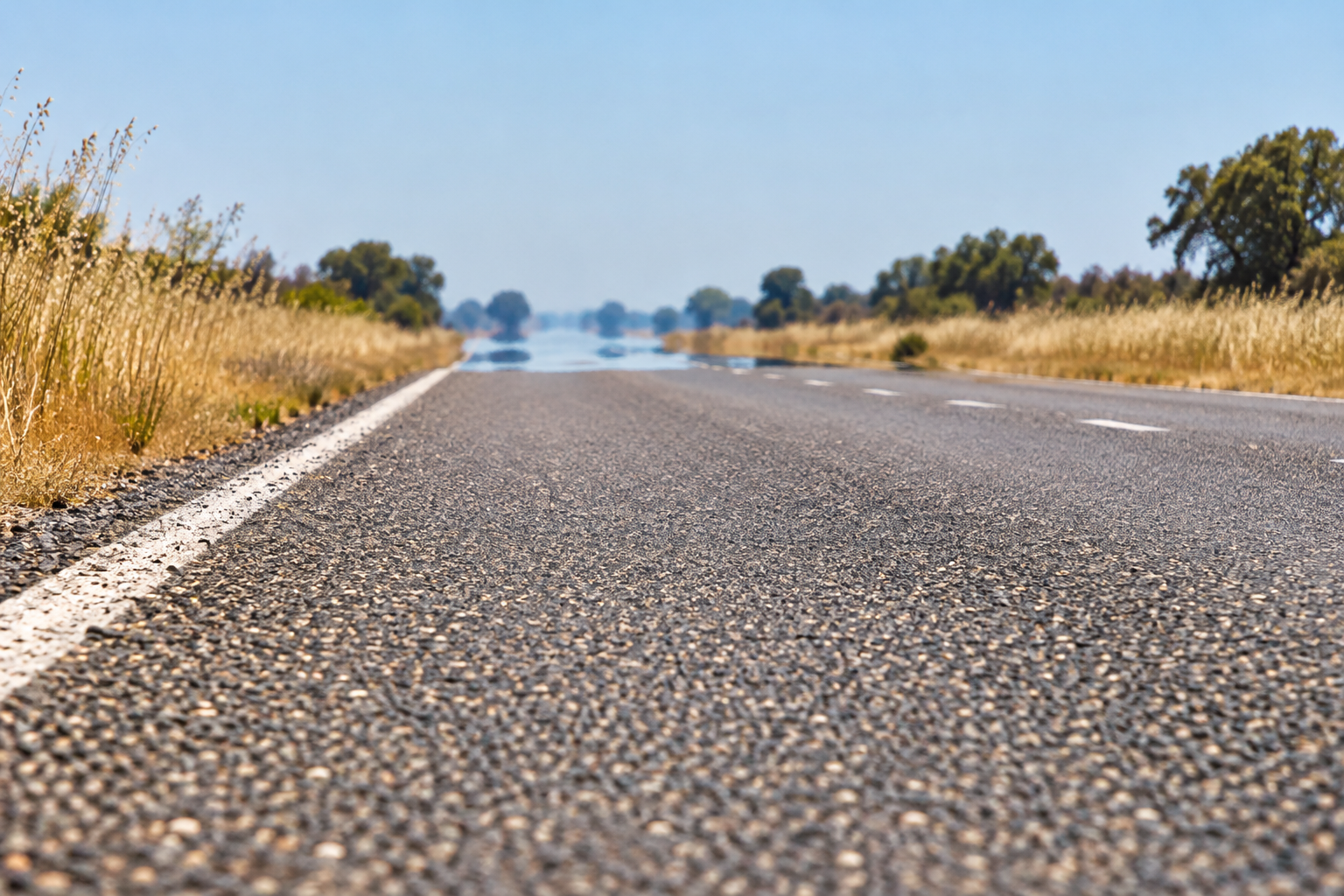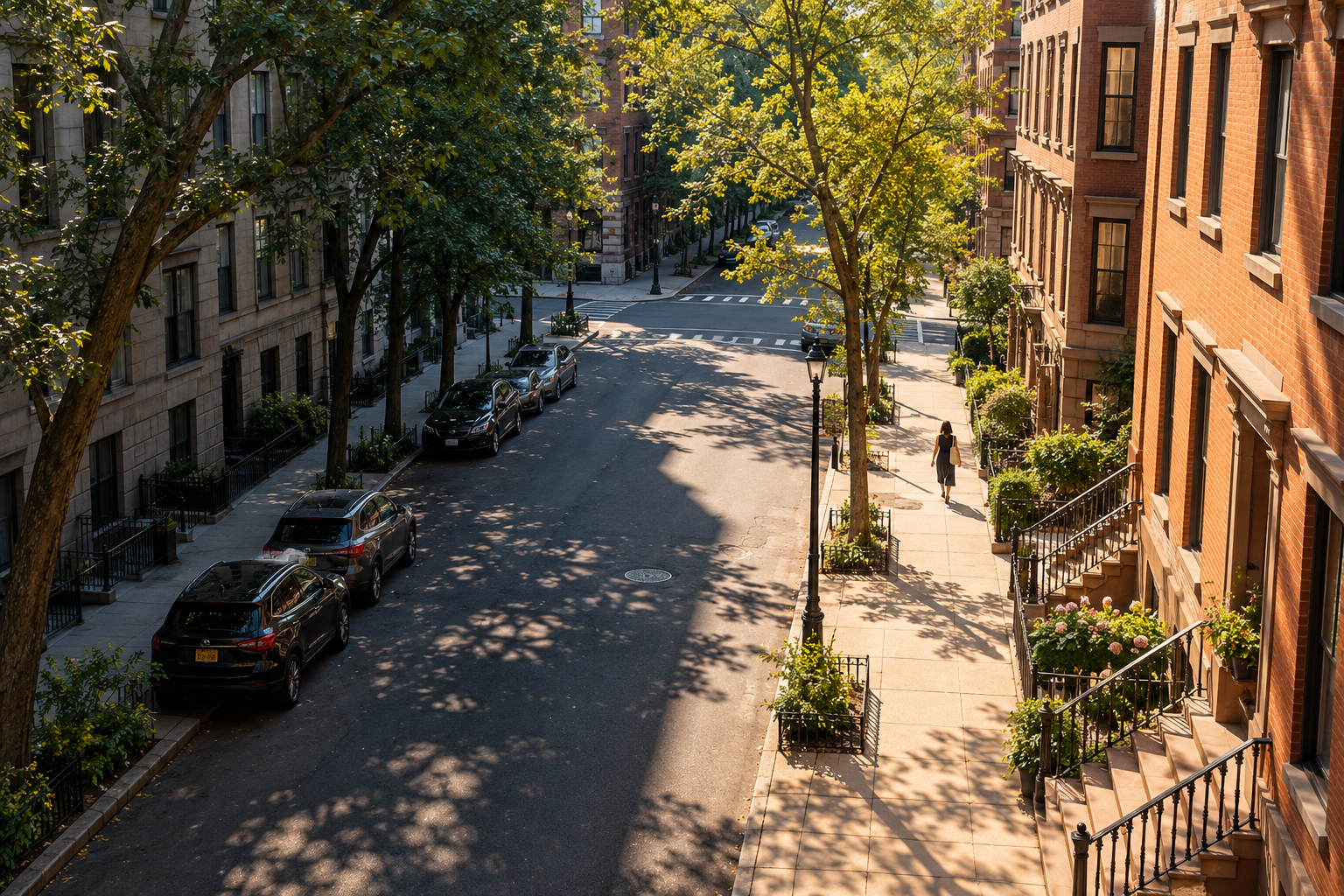
A forecast gives a neighborhood one air temperature. A walk along its streets has more than one answer. A wall blocks the afternoon sun from one pavement while the opposite wall faces it. A tree breaks the light into moving patches. At the corner, air that felt still begins to move. None of this requires the larger weather system to change. The block has changed what reaches a person standing inside it.
Urban researchers call this a microclimate: local conditions shaped by buildings, ground, vegetation and the air moving among them. The word is useful only if we ask which condition we mean. A sunlit paving stone can be far hotter than a shaded one without the air above them differing by the same amount. A person can feel much cooler in shade even when an ordinary air thermometer barely moves.
The pavement and the air are different measurements
In a field study of streets near London South Bank University, researchers placed weather stations and measured road, pavement and wall surfaces. On one summer afternoon, sunlit points in the narrow Keyworth Street canyon warmed toward 35°C while points on the other side stayed near 27.5°C. Those are surface temperatures, not a claim that pedestrians on the two sides breathed air 7.5°C apart. The same study found air-temperature differences between its tree-lined Borough Road and sheltered Ontario Street of up to about 2°C on one day. Different thermometers were answering different questions.
The surfaces matter because they absorb sunlight, store heat and exchange it with the air and with people nearby. But the size of a surface contrast cannot simply be copied onto a weather forecast. London researchers measured air temperature, humidity, radiation and wind at several locations because no one number captured their street layout. Their campaign covered one London site in a summer month; it shows how a block can work, not the temperature difference every city will have.
Buildings make the sun's path legible on the ground. In a Trento, Italy, street-canyon study, sensors placed near opposite walls and above roof level recorded contrasting temperatures when direct sun reached one wall. During sunny periods, the warmer side shifted with the sun; when sunlight was weak or absent, temperatures across the canyon were more alike. The researchers' wall-side sensors were mounted several meters above the pavement, so their readings are evidence about canyon air and wall heating rather than a personal temperature at head height. The principle is visible on an ordinary walk: the shadow line moves while the buildings stay put.
Shade changes the heat a body receives
Air temperature alone also misses radiation. Sunlight reaches a person directly, while warm ground and walls send heat back. Researchers often combine the radiation arriving from different directions into mean radiant temperature. It is a measure of the thermal radiation a person is exposed to, expressed as an equivalent temperature. It is not another reading of the surrounding air.
That distinction was especially clear in measurements in a Freiburg street. On one summer study day, researchers compared a sidewalk shaded by trees with a nearby sunny site. At the peak contrast, mean radiant temperature differed by 32.8°C, while measured air temperature differed by 1.7°C. The result does not mean a tree cooled the air by thirty degrees. It means shade cut the radiant load reaching the study's reference person much more sharply than it changed the local air. The researchers also studied building shade and found a similar separation between the two measures.
The Freiburg numbers belong to specific sites and hours. A narrow street already shaded by tall buildings may gain less extra shade from a new tree than an exposed pavement would. A canopy's shape and the sun's angle change what it covers. When a study reports that shade helps people in heat, the useful question is where the shade falls when people need it, not merely whether a tree appears on an aerial map.
Wind has a street address
The same geometry shapes wind. Air above the roofs does not descend into every street at the same speed or direction. It crosses a roof edge, meets a wall, turns down a side street or circulates within a canyon. In an Athens field campaign, researchers measured airflow inside and outside a street canyon over five hot days. They examined cases in which the larger wind approached along, across and at an angle to the street. Solar heating of the ground and the street's finite length, including the air near intersections, both mattered to the patterns they observed.
Real streets are untidy even by those terms. A field and laboratory study of a narrow street in Nicosia followed wind and traffic-related carbon monoxide at several sections of the same street. Building heights varied; balconies and gaps interrupted the walls. The researchers found that local architectural details and changes in the wind above the roofs could alter flow within the canyon. Their results resist a neat rule such as “the sheltered side is always still.” Depending on wind direction and the precise shape of a corner, shelter and ventilation can change over a short distance.
This is why wind belongs in a description of block-scale weather even on a sunny day. A patch of shade offers less relief if a warm wall radiates toward it; a breeze can change how a person exchanges heat with the air. The same air movement also matters for how street-level emissions disperse. These effects need separate measurements. The Nicosia study's carbon monoxide patterns, for instance, reflected traffic-lane position as well as airflow; they are not a universal pollution map for all street canyons.
After the shadow covers everything
At sunset, the contrast changes rather than simply vanishing. London researchers found that Keyworth Street could remain about 0.5°C warmer in air temperature at night than nearby comparison streets: its restricted view of the open sky reduced how readily its surfaces shed heat upward. In their measurements, the sunlit and shaded surfaces of that street also drew closer together by evening. A morning refuge from direct sun can therefore have a different nighttime behavior.
A scaled outdoor experiment in Guangzhou tested this tradeoff by changing both street width relative to building height and the heat-storage capacity of model buildings. Wider model canyons admitted more daytime sun but cooled more quickly at night; models built to store more heat changed temperature more slowly and released it later. Those are controlled model streets, not measurements of every real block. They help explain why a design that maximizes afternoon shade cannot be judged by one summer afternoon alone.
A useful description of a block therefore needs a place, a height and a time. “Thirty degrees” may describe the background air; “this sidewalk at two o'clock” describes a route through sun, warm surfaces and moving air. To understand the walk, measure the air without confusing it with the pavement, notice where the shadow falls, and return after the sun has moved. The block has no private weather forecast. It has a changing arrangement of exposures within the weather everyone shares.
A thought worth keeping?