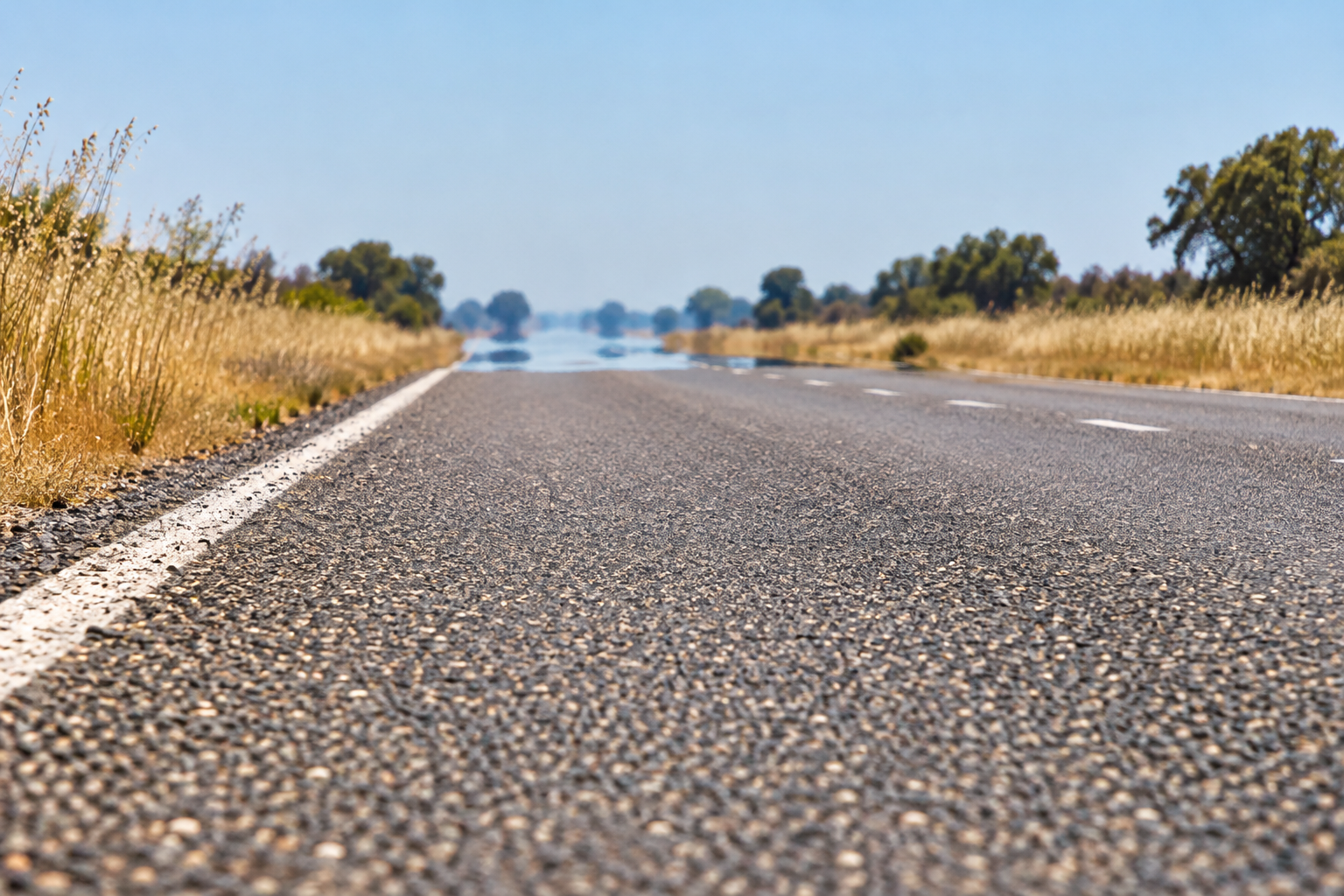
A blue patch lies across a dry road in the distance. It has the flat shine of water until the road draws nearer; then it retreats, taking a row of dark, wavering tree shapes with it. The scene offers a clue about the thin air close to the pavement, but it does not give us a thermometer reading. To understand what we have seen, we need to follow two journeys: heat moving from road to air, and light moving through that air to an eye.
Sunlight can warm a road surface well above the air a person would measure at ordinary breathing height. The surface absorbs some incoming energy, releases thermal radiation, conducts heat into the pavement below and transfers heat to the air touching it. Wind carries some of that air away. Shade, cloud, recent rain, road material and the angle of the sun alter the balance. The air immediately over a sunlit stretch can therefore differ from air only a short distance higher or farther sideways. It is a small, changing piece of weather, not a permanent layer glued to asphalt.
This distinction between surface and air is easy to lose when both are called “the temperature.” A thermometer touching pavement measures the pavement; a shielded thermometer above it measures air at its particular height. In a road-side field experiment in Tsukuba, Japan, researchers placed fifteen ventilated, shielded thermometers at heights of 0.5, 1.5 and 2.5 metres near a ten-metre-wide asphalt road. They also measured the road surface, wind and sunlight. The arrangement let them ask how a road changed nearby air readings rather than assuming the hotter surface and the air shared one temperature.
Why the distant road can look wet
Air does not bend light equally at every density. In a strongly heated layer, the air nearest the road is generally warmer and less dense than the air above it, so its refractive index is slightly lower. A light ray that passes nearly along the road can curve upward through that vertical change. When the ray reaches an observer, the eye extends its final direction backward in a straight line. Light from the sky, arriving by a curved route, then appears to come from low on the road. The blue “water” is sky placed in the wrong part of the scene by the optical path. A distant object can also gain a displaced or inverted image. That is the familiar inferior mirage, named for the image appearing below the object's ordinary position.
The bending is real, even though the puddle is not. In a 2006 laboratory experiment, Lauren Richey, Bailey Stewart and Justin Peatross sent a laser beam through a narrow gap between a hotplate and a pan of ice water. The beam landed at different heights on a distant screen as they changed its path through the temperature gradient. The apparatus used a deliberately extreme gradient over a short path, so its temperatures are no guide to a normal road. It demonstrates the mechanism: a small change in the path of light becomes visible after the beam has travelled farther.
Real road air has a more complicated temperature profile than a neat stack of uniform layers. Andrew Young's quantitative model of inferior mirages uses a profile associated with a convective boundary layer and includes the obstruction caused by roughness near the surface. In that model, both the curved light path and the texture that limits what can be seen close to the ground help set the mirage's apparent edge. The picture's size or brightness alone cannot be turned into a single temperature difference without knowing the viewing height, distance, surface and vertical air structure.
Nor is every wavering patch of the view the same thing as a steady inverted image. The heated air rises and mixes. As its temperature and density vary across the line of sight, the image can ripple or blur from one moment to the next. Michael Vollmer and colleagues recorded visible and thermal-infrared inferior mirages of aircraft on a long paved runway. Their images show distant parts of an aircraft apparently doubled or hidden below a changing visual boundary; they also describe turbulence disturbing mirage images. A runway is not every road, and the study was about optical imaging rather than roadside air-temperature forecasts. It is useful evidence that image geometry and motion matter to what an observer sees.
There is a further caution. Researchers on one road in Wuhan photographed mirror-like images both on a hot summer day and on a winter day when their measurements showed no obvious temperature gradient above the surface. They argued that light reflected or scattered from the rough road at a very shallow angle could explain the winter image. Their 2011 field study challenges the idea that every road reflection must be an air-refraction mirage. It does not erase laboratory demonstrations of bent rays or field observations of mirages elsewhere. Seen from afar, a road can combine surface reflection, curved light paths and flickering air; a glossy-looking patch by itself cannot tell us which contribution dominates.
What a thermometer finds
The Tsukuba measurements show why looking at height and wind matters. During the summer observations, with the measured side of the road downwind, air at 0.5 metres was on average about 0.2 to 0.4 °C warmer than at the corresponding reference site upwind. The difference tended to be greater nearer the road and with weaker wind. At 1.5 metres, effects were smaller and appeared only at some times; at 2.5 metres, some summer readings were slightly cooler rather than warmer. The researchers also found changes through the day, including an evening maximum in the warm bias at low height. Those measured values belong to that open, grassy test site, its road and its observing periods. They are not a correction to add to every weather station near pavement.
Wind does more than cool a surface in a general way. It determines where road-warmed air goes. A sensor on the downwind side may sample air that has crossed the asphalt, while an equally distant sensor upwind may not. Buildings make the pattern less tidy. In summer and winter measurements in a Trento street canyon, sensors near opposing walls recorded marked contrasts when direct sunlight struck one side; when solar radiation was weak or absent, the measured temperature field was more even. Those observations concern a street bounded by buildings, where walls, shade and air circulation join the road surface in shaping the air. They help explain why an open highway and an urban block cannot be read as interchangeable experiments.
The road also has a memory of the day's energy. A surface can keep releasing stored heat after the sun's angle has changed, while wind or shade can undo an earlier pattern. The Tsukuba team found its strongest low-level roadside bias in the evening, not at an assumed universal noon peak. That detail is a useful guard against a tidy but misleading story: the hottest-looking hour, the hottest surface hour and the largest temperature difference at a chosen thermometer height need not coincide.
If the question is about local weather, the measurements must match it. A surface thermometer or infrared instrument can follow the pavement. Several radiation-shielded air thermometers at stated heights can show how quickly the near-road effect fades or changes sign. A wind observation tells us which air has crossed the road; repeated readings show whether a pattern survives more than a passing gust. A camera records what light did along a long viewing path. Each instrument observes something valuable, but none substitutes automatically for the others.
The distant blue patch may vanish as the observer approaches because the shallow sightline and long path through the low air have changed. It was never a fixed pool waiting at a fixed mile marker. That is the pleasure of watching it carefully: a familiar road reveals both a surface exchanging heat with the air and an atmosphere capable of moving the landscape we think we see.
A thought worth keeping?